The Improbable Wendell Willkie by David Levering Lewis
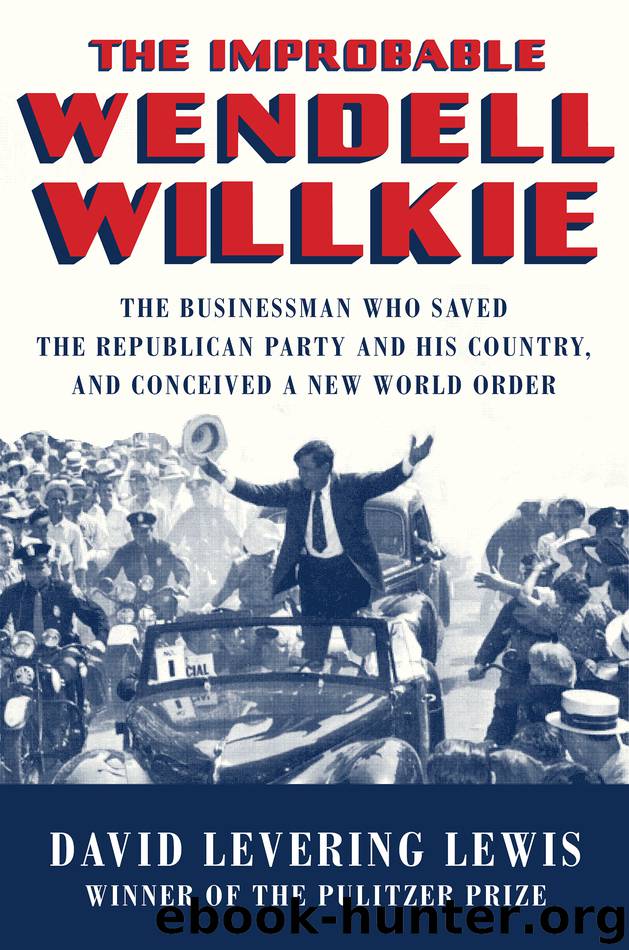
Author:David Levering Lewis
Language: eng
Format: epub
ISBN: 9781631493744
Publisher: Liveright
Published: 2018-09-02T16:00:00+00:00
CHAPTER 9
EXCEPTIONALISM AT WORK
1943 Detroit Riot reenacted, Willkie and team. Courtesy the Lilly Library, Indiana University, Bloomington, Indiana.
To a Forty-Eighter descendant, the dividend of immigration was obvious after some two hundred years of “new blood, new experiences, new ideas.” His essay in the June 1942 Saturday Evening Post, “The Case for Minorities,” like his “Fair Trial” two years earlier, was a puissant apology for the fact that it had even been necessary to write it. Three months earlier, the Saturday Evening Post had caused a firestorm of protest with “The Case Against the Jews,” an article by a non-practicing Jew blaming German Jews for their own plight and widely deemed anti-Semitic. Scrambling to recover from its self-infliction, and claiming “many readers” suggested a rebuttal from Wendell Willkie, the editors published what Wendell decried as “only disease and death in the wailing distortion of Mr. Milton Mayer’s recent flagellation of the Jews.” Because the benefit of racial and religious diversity was self-evident, Wendell conceded that the only purpose served by his rebuttal was as a forewarning, lest the tensions brought on by war and competing ideologies reintroduce the ignominies of the Ku Klux Klan and “such calamities as the series of race riots in our cities which grew out of the emotionalism of the First World War” (finally mentioned after two decades of silence).
Twenty-three years earlier, Captain Willkie had returned from the Great War without recorded notice of the “Red Summer” of 1919 during which a streak of interracial carnage from May to October reddened the streets of Charleston, South Carolina; Washington, DC; Longview, Texas; Chicago; Knoxville; and Omaha, leaving some African Americans lynched, many killed, and thousands shaken, abused, impoverished, embittered. Even though brief and belated, Wendell’s article’s acknowledgment signaled his keener appreciation of an American perennial: racism. For good measure, four good-sized iconic photos illustrating the nation’s diversity dominated “The Case for Minorities”—a Native American, African American, Chinese American, Slavic American. Its author closed his notable piece with a warning that “our way of living together in America is a strong but delicate fabric. . . . For God’s sake, let us not tear it asunder. For no man knows, once it is destroyed, where or when man will find its protective warmth again.” Pearl Harbor had quieted the Nyes, Lindberghs, Father Coughlins, and Bilbos for the time being, but the prejudices they espoused lay ready for new marching orders. Six months later, December 17, the distinguished board of the American Hebrew magazine, honorary member FDR voting affirmatively, bestowed its annual American Hebrew Medal on a deeply moved Wendell Willkie.1
The evolution of Wendell’s civil rights pivot in the spring of 1942 followed a steady course few politicians in either major party—with the somewhat later example of Henry Wallace—would risk until well after the end of the war. Unquestionably instigated by the prospective balance of power calculus of African American ballots as the Great Black Migration, interrupted by the Great Depression, resumed, Wendell’s race relations outreach was the principled prescience of a politician ready to advance democracy through demography.
Download
This site does not store any files on its server. We only index and link to content provided by other sites. Please contact the content providers to delete copyright contents if any and email us, we'll remove relevant links or contents immediately.
Fanny Burney by Claire Harman(26605)
Empire of the Sikhs by Patwant Singh(23089)
Out of India by Michael Foss(16856)
Leonardo da Vinci by Walter Isaacson(13339)
Small Great Things by Jodi Picoult(7148)
The Six Wives Of Henry VIII (WOMEN IN HISTORY) by Fraser Antonia(5518)
The Wind in My Hair by Masih Alinejad(5099)
A Higher Loyalty: Truth, Lies, and Leadership by James Comey(4965)
The Crown by Robert Lacey(4818)
The Lonely City by Olivia Laing(4804)
Millionaire: The Philanderer, Gambler, and Duelist Who Invented Modern Finance by Janet Gleeson(4481)
The Iron Duke by The Iron Duke(4362)
Papillon (English) by Henri Charrière(4277)
Sticky Fingers by Joe Hagan(4204)
Joan of Arc by Mary Gordon(4116)
Alive: The Story of the Andes Survivors by Piers Paul Read(4035)
Stalin by Stephen Kotkin(3970)
Aleister Crowley: The Biography by Tobias Churton(3642)
Ants Among Elephants by Sujatha Gidla(3468)
